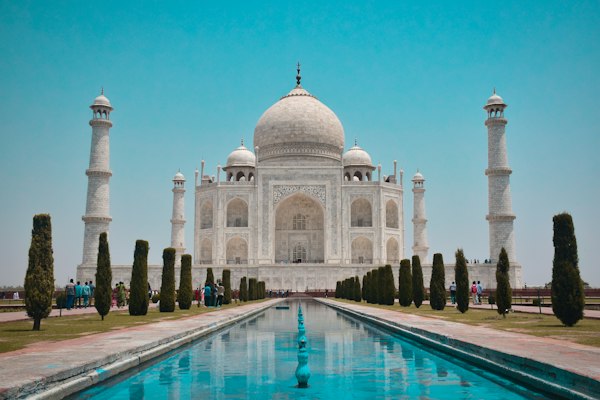
Most travellers arrive at the Taj Mahal having read three different ticket prices online, none of them current, and at least one of them invented by someone selling a tour. So here is the entire cost of visiting the Taj as a foreigner in 2026, line by line, with nothing rounded off and nothing hidden. I lead this walk most mornings; these are the real numbers.
What does the Taj Mahal ticket cost for foreigners in 2026?
The base foreigner ticket is ₹1,300 — about $16 or €15 at current rates. That single ticket is more generous than most people realise. It already includes:
- A pair of shoe covers (mandatory on the marble platform)
- A 500ml bottle of water
- A token for the free e-rickshaw or golf cart from the ticket plaza to the gate
Petrol and diesel vehicles are banned within 500 metres of the Taj to protect the marble from acid pollution, so that last stretch is electric — and you’ve already paid for it. Tourists routinely pay touts ₹100–200 for a ride that their ticket already covers.
The one genuine extra is the main mausoleum chamber — the inner room holding the false tombs of Shah Jahan and Mumtaz Mahal. That costs ₹200 more, paid separately at a small counter inside. Everything else — the gardens, the great gate, the mosque, the jawab, the riverside platform, every photo angle — is covered by your ₹1,300.
Who pays what? The full price tiers
| Visitor category | Base ticket (2026) | Notes |
|---|---|---|
| Indian national | ₹50 | Aadhaar / ID may be checked |
| SAARC & BIMSTEC national | ₹540 | Nepal, Bhutan, Bangladesh, Sri Lanka, etc. |
| Foreign national | ₹1,300 | + ₹200 for the mausoleum |
| Child under 15 (any nationality) | Free | ID for age may be requested |
Yes, a foreigner pays 26 times what an Indian pays. This is official, published, two-tier pricing used at the Red Fort, Qutub Minar, Amber Fort and almost every major Indian monument. It is not a scam and it is not negotiable. Build it into your budget and move on — the monument is worth ₹1,300 several times over.
The three gate scams that cost tourists the most
After the ticket, the real money disappears in small cons at the gate. The three most common, in order of how often I see them:
- The “free” guide. A friendly man attaches himself to you, offers to “just help,” then demands ₹1,000–2,000 at the end — and he never even entered the marble area, because unlicensed guides legally can’t. A real guide carries a Ministry of Tourism photo licence; ask to see it before anyone walks with you.
- The e-rickshaw “fee.” Someone charges you ₹100–200 for the buggy to the gate. It’s free. It’s on your ticket.
- The photo “spot fee.” A man positions you at the classic bench, takes your phone, shoots, then asks for ₹500. Your guide takes those same photos for free — it’s part of the service, and it’s why our reviews are full of “amazing photos.”
What does a complete Taj visit actually cost?
For one foreign traveller who wants to do it properly — base ticket, mausoleum, a shared licensed guide, and nothing wasted on touts:
| Item | Cost (₹) | Cost ($) |
|---|---|---|
| Base foreigner ticket | 1,300 | ~16 |
| Mausoleum chamber | 200 | ~2.5 |
| E-rickshaw, water, shoe covers | 0 (included) | 0 |
| Government fees per person | 1,500 | ~$18 |
These are the fees the Archaeological Survey of India charges, published here so you can check any receipt against them — we never mark them up.
A licensed guide sits on top of that and is charged per group of up to 5, not per person, so the cost per head falls sharply with group size: a couple splits it two ways, a family of five splits it five ways. We quote ours in writing before you book, so you know the number in advance rather than negotiating it at the gate. None of this includes getting to Agra — see our guide on reaching Agra from Delhi for that.
How to pay, and what to carry
Tickets are sold online at asi.payumoney.com (slightly cheaper, skips the queue) or in cash at the counter. Bring your passport — it can be checked against the foreigner ticket. We pre-book our guests’ tickets at no markup so they bypass the ticket line entirely and go straight to security.
One last thing: keep your ticket. It’s scanned at multiple points, and the mausoleum counter wants to see it. Lose it and you’re buying again.