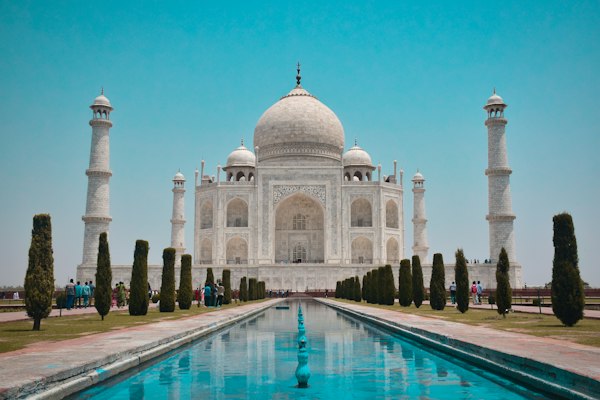
Stand at the great gate of the Taj Mahal at 6:20 in the morning and the marble in front of you is the colour of the inside of a seashell — a soft, bruised rose that seems to come from within the stone rather than fall on it. Wait ninety minutes. The same marble is now a flat, blazing white that hurts to look at. Come back at dusk and it has turned the warm amber of honey held to a candle. Travellers ask me the same question every single day: what is going on?
The short answer is that the Taj Mahal is the most expensive mirror ever built.
Does the Taj Mahal actually change colour?
No — and this is the part that surprises people. The marble does not change. The sky does, and the marble is honest enough to show it.
The Taj is clad in Makrana marble, quarried about 400 km away in Rajasthan and hauled to Agra by an estimated 1,000 elephants in the 1630s. Makrana is not ordinary building stone. It is exceptionally pure calcite, fine-grained and low in pores, which makes it slightly translucent: light does not simply bounce off the surface, it sinks a centimetre or three into the stone, scatters among the crystals, and comes back out. The marble glows the way skin glows in soft light, not the way a painted wall reflects.
Because the stone re-emits the light that enters it, it takes on the colour of whatever is lighting it. At dawn the sky is full of long, scattered red wavelengths, so the Taj reads pink. At noon the sun is white and overhead, so the Taj reads white. At sunset the warm wavelengths return and the Taj turns gold. Under a full moon, the cool reflected light turns it a pale blue-silver.
It is not that the Taj changes its mood. It is that the Taj has no opinion of its own, and shows you the sky’s.
What colour is it at each time of day?
Here is what our guests actually see across a clear winter day:
| Time | Colour | Why |
|---|---|---|
| First light (pre-sunrise) | Cool rose-grey | Soft, diffuse, low-angle light |
| Sunrise + 30 min | Pink-gold | Peak warm scattering; the famous shot |
| Mid-morning (9–11 AM) | Brilliant white | High white sun, marble at full glare |
| Afternoon | Warm cream | Sun angle drops, warmth returns |
| Last hour before sunset | Amber-gold | Long warm wavelengths again |
| Full-moon night | Blue-silver | Cool reflected moonlight |
This is also why a sunrise visit is worth the painful alarm. The pink-to-white transition happens in roughly the first forty minutes after the gates open, and there is no way to see it later in the day. By the time the day-trip buses from Delhi arrive at 10 AM, the show is over and the marble is simply white.
Was the colour change intentional?
This is where physics meets poetry. Court chronicles from Shah Jahan’s reign, and the oral tradition passed down among Agra’s guide families, hold that the colour-shift was understood and even intended by the builders. The Taj was raised as a mausoleum for Mumtaz Mahal, the emperor’s wife, who died in 1631. The changing colours were read as a metaphor for the changing moods of a woman — luminous, never the same twice, impossible to fully hold.
Whether or not the chief architect planned for Rayleigh scattering — he did not have the physics vocabulary, but he had centuries of marble craft — the effect was certainly known. The Mughals positioned the monument, its reflecting pools and its riverside setting with obsessive care. They knew exactly what the marble did at dawn.
How do you see it for yourself?
Three practical rules, learned from leading this walk thousands of times:
- Enter at opening. Gates open roughly 30 minutes before sunrise — about 6:00 AM in summer, 6:45 AM in winter. Be at the ticket counter 30 minutes before that.
- Pick a clear, dry morning. November and February give the cleanest air and the most dramatic colour. December–January fog can grey the whole thing out; the monsoon flattens it.
- Stand on the central platform, then move. The colour reads differently from the reflecting pool, the mosque side, and up close against the inlay. A good guide walks you through all three before the white sets in.
If you want the pink-gold version of the Taj — the one in every postcard — there is exactly one way to get it: be inside before the sun is. Everything after that is a different, whiter monument.