jaipur · attraction
Plan your visit to Jantar Mantar
Jantar Mantar is an 18th-century astronomical observation site in Jaipur housing the world's largest stone sundial, a UNESCO World Heritage Site still accurate to this day.

Taj Mahal · East Gate · 06:24 IST
What Is Jantar Mantar?
Jantar Mantar in Jaipur is the largest and best-preserved of five astronomical observatories built by Maharaja Sawai Jai Singh II between 1724 and 1735. UNESCO inscribed it as a World Heritage Site in 2010, recognizing it as an outstanding example of the meeting of scientific and architectural traditions (source: UNESCO World Heritage List).
The site contains 19 astronomical instruments, some reaching over 27 meters in height, each designed for a specific astronomical observation. Jai Singh II, himself a scholar and astronomer, was dissatisfied with the accuracy of brass instruments of his era and commissioned these monumental stone instruments to achieve greater precision.
What Are the Key Instruments?
The Samrat Yantra (Supreme Instrument) is the site’s centerpiece and the world’s largest stone sundial. Its gnomon (triangular structure) stands 27 meters tall, aligned precisely with the Earth’s axis, and casts a shadow that moves approximately 1 mm per second. It can determine local solar time to an accuracy of approximately 2 seconds (source: ASI).
The Jai Prakash Yantra consists of two hemispherical bowls set into the ground, representing inverted maps of the sky. A suspended ring casts a shadow onto the carved marble surface, allowing observers to determine the position of the sun and other celestial bodies.
The Ram Yantra is a pair of cylindrical structures with open tops used for measuring the altitude and azimuth of celestial objects. The Rashivalaya Yantra is a collection of 12 instruments, each aligned to one of the 12 zodiac signs, used for calculating celestial positions.
How Should You Plan Your Visit?
Jantar Mantar sits adjacent to City Palace and a 5-minute walk from Hawa Mahal. Our guides typically visit all three together in the late morning during the Jaipur day tour and the Golden Triangle tour.
We cannot overemphasize the value of a guide at Jantar Mantar. Without explanation, the instruments appear to be monumental abstract sculptures. With a knowledgeable guide, the site transforms into a hands-on science lesson — our guides demonstrate how each instrument works using real-time shadow readings, making this one of the most intellectually engaging attractions in Jaipur.
The site is compact and flat, making it accessible for most visitors. Midday visits offer the most dramatic sundial demonstrations when the sun is high and shadows are sharp and well-defined.
Photo Gallery
Location
Tripoliya Bazaar, near City Palace, Jaipur, Rajasthan 302002
More Attractions in Jaipur
 jaipur 2-3 hours
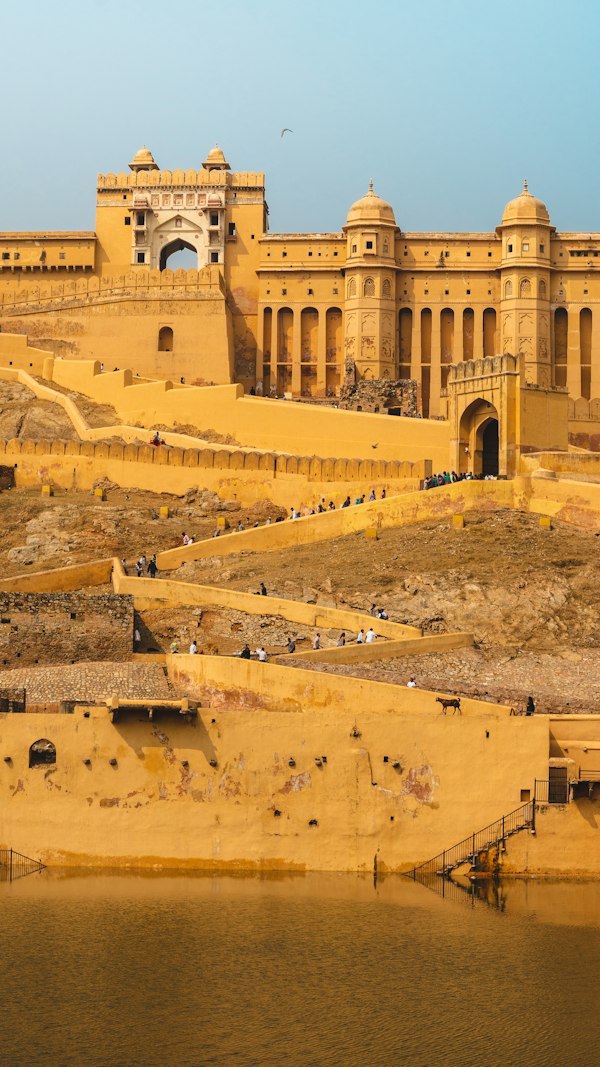
 Amber Fort
Amber Fort (Amer Fort) is a majestic hilltop fortress 11 km from Jaipur, blending Rajput and Mughal architecture with the celebrated Sheesh Mahal (Hall of Mirrors).
 jaipur 1.5-2 hours
 City Palace
Jaipur's City Palace is a magnificent complex of courtyards, gardens, and buildings that remains the residence of the Jaipur royal family and houses a world-class museum.
 jaipur 45 minutes – 1 hour
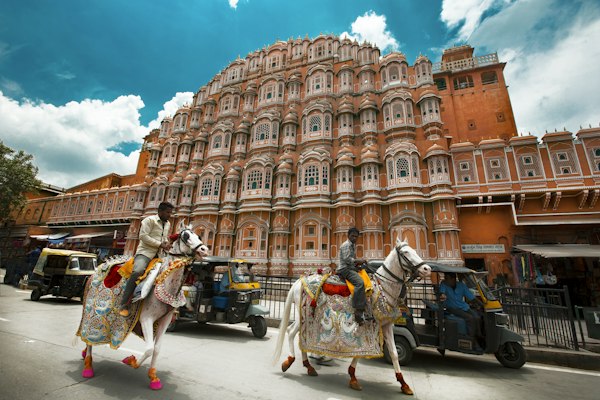
 Hawa Mahal
Hawa Mahal (Palace of Winds) is Jaipur's most iconic landmark, a five-story pink sandstone facade with 953 ornate windows built in 1799 for royal women to observe street life.
Tours Including Jantar Mantar
 3 Days / 2 Nights
 Golden Triangle Tour — 3 Days
- Sunrise visit to the Taj Mahal
- Guided tour of Red Fort and Jama Masjid in Old Delhi
- Elephant/jeep ride to Amber Fort
5 Days / 4 Nights Golden Triangle Tour — 5 Days
- Sunrise and sunset Taj Mahal views
- Chandni Chowk food walk in Old Delhi
- Amber Fort with Sheesh Mahal candlelight demo
1 Day Jaipur Day Tour
- Amber Fort with Sheesh Mahal (Mirror Palace)
- Hawa Mahal — the iconic Palace of Winds
- City Palace museum and royal collections
Frequently Asked Questions
What is Jantar Mantar?
Jantar Mantar is an astronomical observation site built in 1734 by Maharaja Sawai Jai Singh II. It contains 19 large-scale geometric instruments for measuring time, predicting eclipses, tracking star positions, and determining celestial altitudes. UNESCO listed it as a World Heritage Site in 2010.
What is the entry fee for Jantar Mantar?
Indian nationals pay ₹50 and foreign tourists pay ₹200. A composite ticket covering multiple Jaipur monuments is also available.
How accurate is the sundial at Jantar Mantar?
The Samrat Yantra, at 27 meters tall, is the world's largest stone sundial and can measure time to an accuracy of approximately 2 seconds of local solar time, according to the Archaeological Survey of India.
Do you need a guide at Jantar Mantar?
We strongly recommend a guide. The instruments are scientific tools that require explanation to appreciate. Without context, they appear to be abstract stone structures. Our guides demonstrate each instrument's function in real time.
How long does it take to visit Jantar Mantar?
With a guide, plan 45 minutes to 1 hour. The site is compact but information-dense. Combined with the adjacent City Palace and nearby Hawa Mahal, the three make a half-day itinerary.
Plan your trip
Want a Guided Tour of Jantar Mantar?
Our licensed guides bring history to life with stories and insights you won't find in any guidebook.